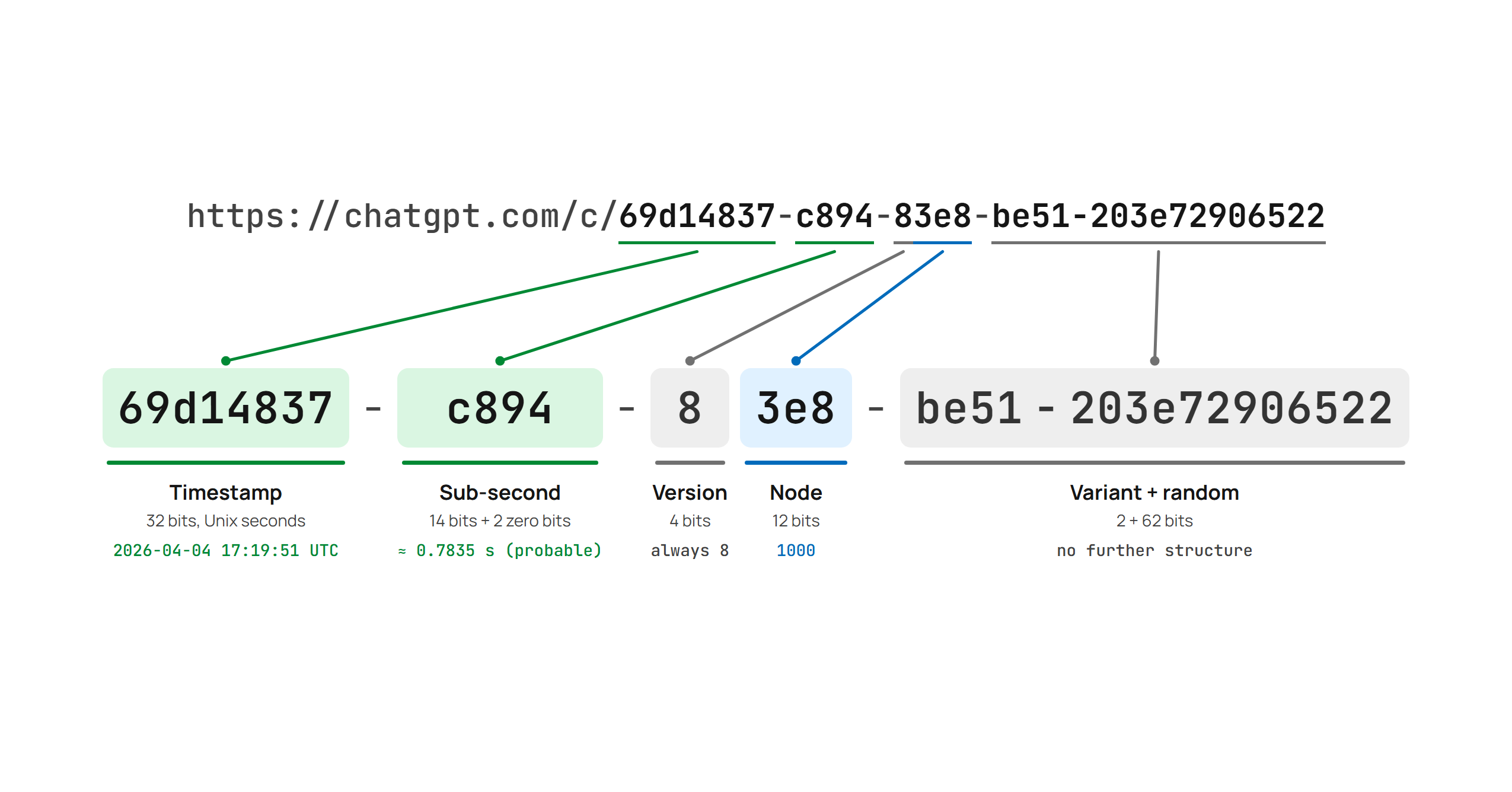
Extracting Timestamps from ChatGPT IDs
Since mid-2024, ChatGPT conversation IDs (and more!) have been UUIDv8s with an extractable creation timestamp. This post explains the ID structure and how to extract the timestamp.
Since mid-2024, ChatGPT conversation IDs (and more!) have been UUIDv8s with an extractable creation timestamp. This post explains the ID structure and how to extract the timestamp.
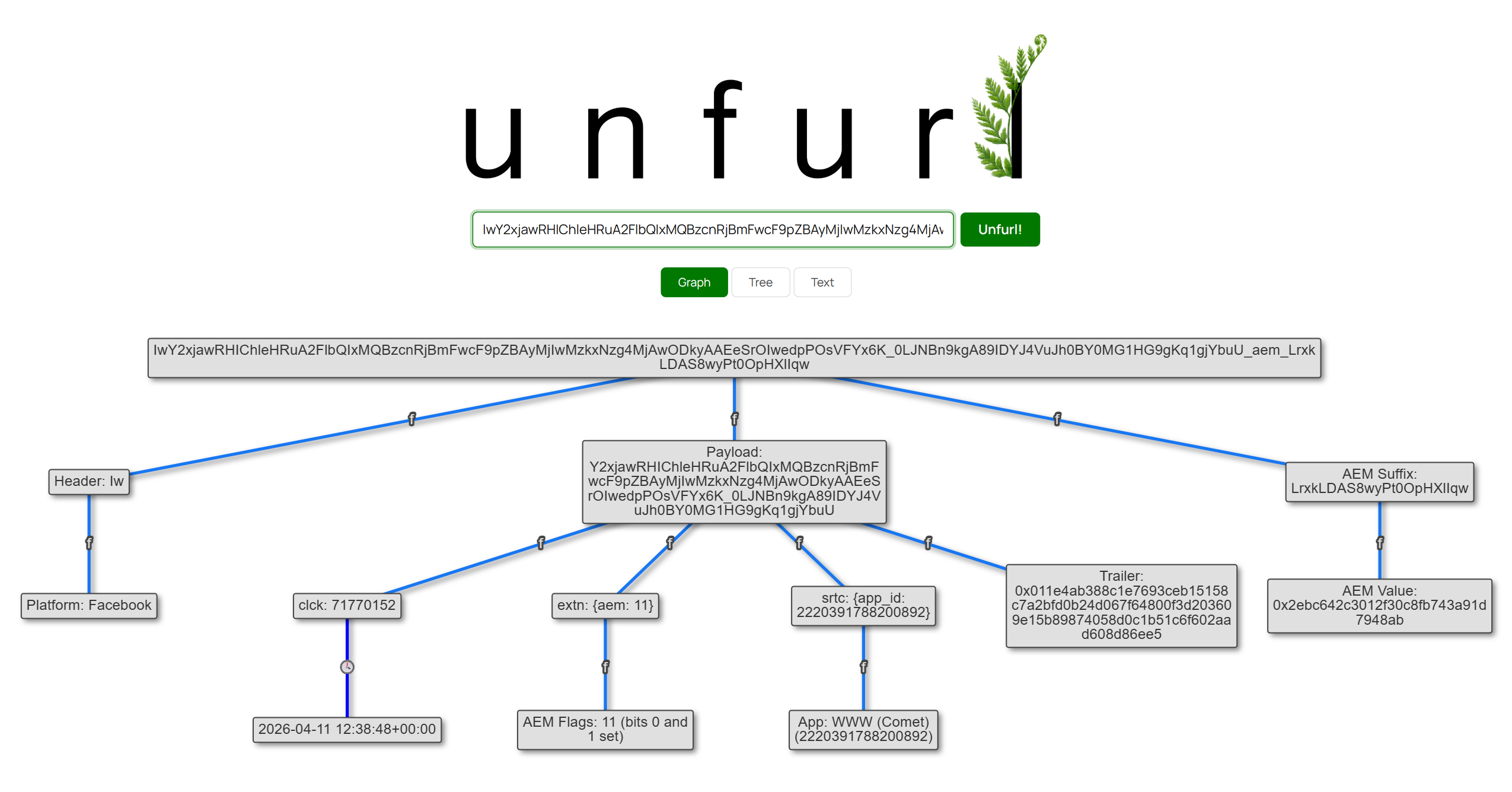
Newer fbclid values contain extractable click timestamps, a browser ID, the source app, and more.
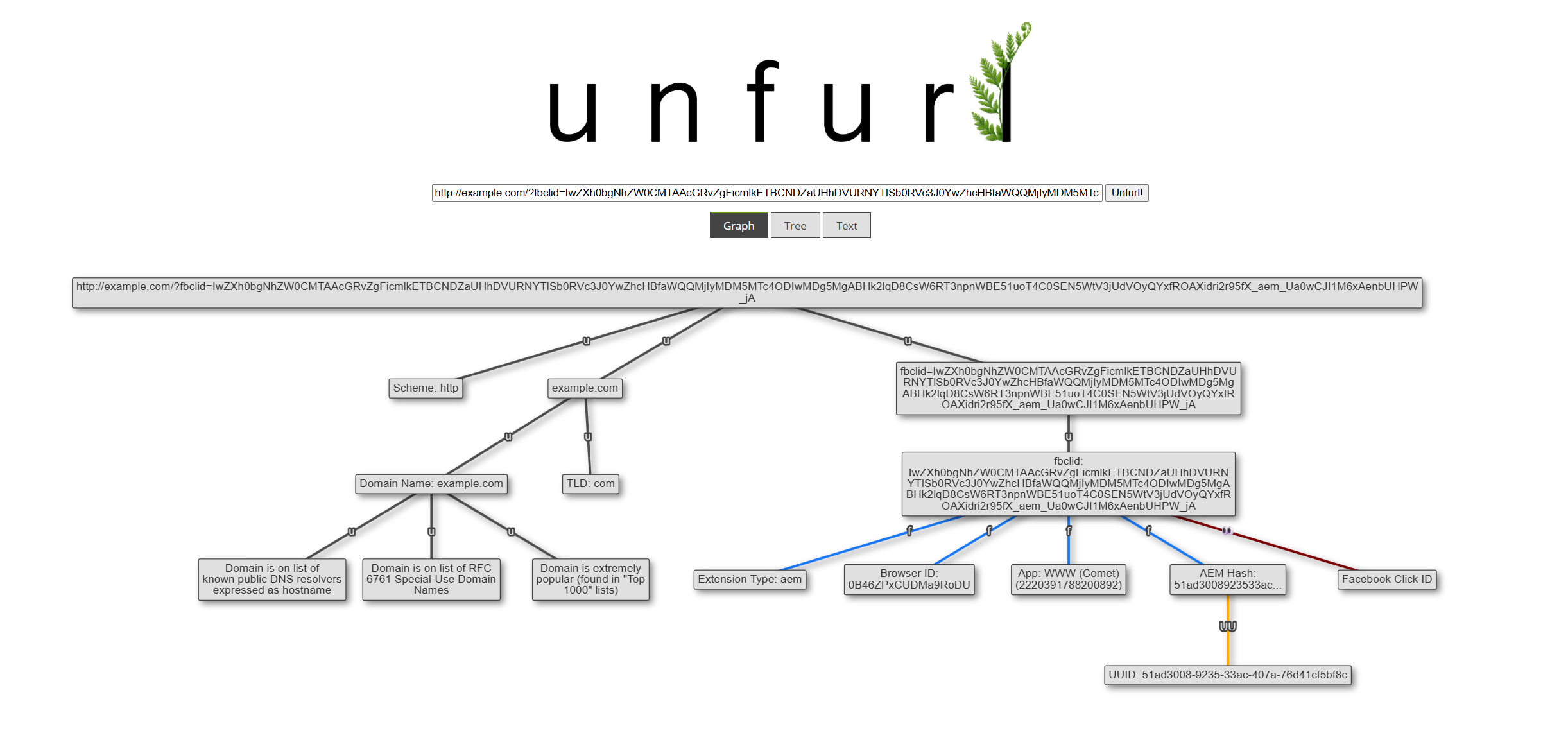
Unfurl v2026.09 adds parsers for Gmail, Safe Links, Facebook, Instagram, and GitHub, decodes more timestamps in tokens and IDs, and gives the web UI new Tree and Text views.
dfir.blog is now Hindsight Foundry: a site dedicated to browser forensics research, open source tools, and related resources.

Hindsight now supports Mozilla Firefox! Other new features include parsing Service Worker-related data and parsing additional sources for extensions and downloads.

Hindsight v2026.04 adds parsing of Session files (including form data), platform notifications, & Google Knowledge Graph lookups for page categories and entities!

Hindsight v2026.01 brings new features, including parsing Sync Data, an updated terminal interface, improved output formats, and dozens of fixes and enhancements.

Unfurl v2025.03 adds new features, including parsing Google Search's UDM parameter, support for Mastodon forks (like Truth Social), and a utility parser to "clean up" inputs.
Hindsight v2025.03 focuses on Extensions - parsing more activity and state records, highlighting Extension permissions, and making it easier to examine Manifests.

Unfurl v2025.02 adds parsing of obfuscated IP addresses, more Bluesky timestamps, and more!
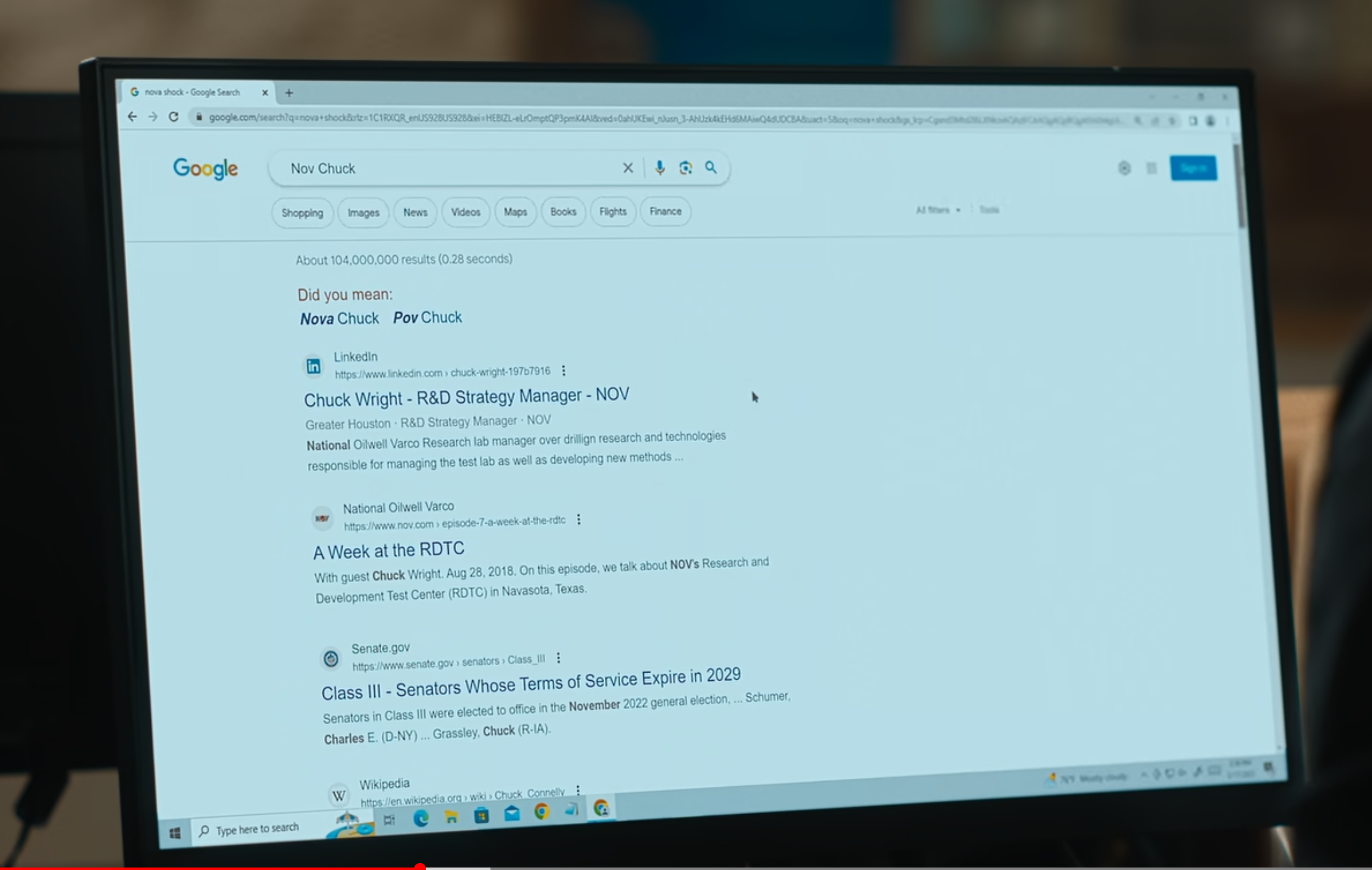
I watch Netflix's Carry-On, notice a real Google Search URL on screen, extract lots of data points from it and "authenticate" the screenshot.

The talk "What Can DFIQ Do For You?" that Jon Brown and I gave at the SANS DFIR Summit 2023 has been posted on YouTube!

Unfurl v2023.09 adds parsing for JWTs, URLs with encoded DoH (DNS over HTTPS) requests, and more Mastodon servers.

This "social media edition" Unfurl release includes parsing Twitter sharing codes, timestamps from Mastodon and LinkedIn IDs, expanding Substack redirects, & more!

Unfurl v2022.02 adds parsing for Google Search's aqs parameter, integrates MISP "warninglists", adds 3x more shortlink expansions, and more!

Hindsight v2021.12 adds parsing of more preference items, site settings (including HSTS records), Session Storage, and more!

To support stronger security for Chrome, some network-related files - including the Cookies database - are moving locations on disk.

A new Unfurl release is here! v2021.06.15 adds decoding of some Metasploit URLs, hash identification and API lookups, & more!
Hindsight 2021.04.26 has many small improvements and fixes, including support for Chrome 88 - 90, but the main new features are an Unfurl plugin and parsing of the Site Characteristics Database!

I take saved keystrokes from Chrome's Omnibox and graph them in a Sankey flow diagram.

Latest Hindsight version (2021.01.16) brings exciting new features: improved LevelDB parsing (including deleted!), viewing Hindsight results in the web UI, and more!

A look back at a year of tweeting every day about DFIR topics - including a recap of the most popular tweets, coverage trends, and what's next in 2021.

I sat down with Jessica Hyde (from Magnet Forensics) on her "Cache Up" podcast to talk about my DFIR career, open source projects, and how folks getting into DFIR can find an area to dig into.

There's a new database added in Chrome 86, dedicated to tracking media playback. Here's a first look at its contents!

A few weeks ago I was on "Life Has No Ctrl+Alt+Del" with @HeatherMahalik of Cellebrite giving an overview of Unfurl, how to use it, and walking through (many) examples. The video recording is now up!

My talk "Extract and Visualize Data from URLs using Unfurl" at the SANS DFIR Summit 2020 has been posted on YouTube! I had a great time presenting at the first ever virtual DFIR Summit (yay 2020). Che

I tinker with TikTok - and find a timestamp embedded in video URLs!

A new version of Unfurl is here! v20200729 adds improved Google Search URL parsing (RLZ and EI parameters), more short-link expansions, DuckDuckGo search parsing, and mailto link parsing.

The rlz parameter in Google Search URLs isn't as mysterious as many others; Google explains what it is and how it functions in a white paper.

A new Unfurl version brings a CLI tool & easier installs via PyPI.

Hindsight is 2020! ... ok, it's actually 20200607, but I've been waiting years to make a bad "Hindsight 2020" joke. There's a new version of Hindsight!

With this latest update, Unfurl can now parse protobufs as well! If you hover over a field, Unfurl tries to explain a bit about wire types and possible other data formats.

Unfurl has been a fun tool, but I've heard you: it's boring. This update to Unfurl will change all that!

The "ved" parameter in Google URLs contains valuable link context. I've found a new version ("v2") with more info!

Ryan Benson on Dave Cowen's Forensic Lunch talking about Unfurl (and other DFIR things).

Unfurl takes a URL and expands ("unfurls") it into a directed graph, extracting every bit of information from the URL and exposing the obscured.

Part 3 in the Deciphering Browser Hieroglyphics series examines LevelDB databases and Chrome's FileSystem.

The second post in "Deciphering Browser Hieroglyphics" discusses LocalStorage and using CyberChef to decode it.

Hindsight v2.4.0 adds JSONL output, support for the newest versions of Chrome (1-76), and other small fixes.

In this first post in "Deciphering Browser Hieroglyphics" I introduce Chromotopia and our artifact deciphering approach.

I took a crack at the Magnet Forensics CTF using the open source tools we use/build here at Google: Plaso, Timesketch, and Colab/Python.

A quick (forensic) look at the new Chromium-based Edge web browser. TL;DR: it looks a lot like Chrome.

Hindsight v2.3.0 adds input path searching, parsing of LocalStorage LevelDB files, support for newer versions of Chrome (1-73), and minor fixes.

I've fielded a few questions recently about what some value buried in a Chrome artifact means, so I'm putting some of the value tables I look up often here on this page.

As part of keeping Hindsight up to date, I started documenting the database structures for each version of Chrome as it was released.

2019 is here and the new year brings something with it I've wanted to do for a while: re-launch my blog! It has a new look and a new home at dfir.blog.

Hindsight is a free tool for analyzing web artifacts. It started with the browsing history of the Google Chrome web browser and has expanded to support other Chromium-based applications.

I spoke at the SANS DFIR Summit 2018 on "Efficiently Summarizing Web Browsing Activity" in Austin, TX. SANS recently posted the recording; enjoy!

I was interviewed by BBC Click for their "What is GDPR?" episode and got to talk about browser forensics on TV.

Hindsight v2.2.0 adds parsing of more preference items and support for newer versions of Chrome (1 - 66).

I spoke about "Deciphering Browser Hieroglyphics" at the SANS DFIR Summit 2017 in Austin, TX. I talked about how to "decipher" different kinds of information stored in web browsers, using a variety of

Encrypted iPhone backup? That means it's useless to an investigator (or attacker), right? Not so fast. We can still get an incredible amount of insight from the metadata alone.

Hindsight v2 is here! The new release brings new features, many of which are focused on ease-of-use, along with a refactoring of the code into a Python package pyhindsight.

Two common questions when investigating web browsing are: (1) how long did a user spend on a website, and (2) what actions did they take while on it?

I was going through my bookmarks and found a write-up from a few years ago on decoding NetScaler load balancer cookies.

The Amazon Echo is a nifty little device that you communicate with via speech. The forensic investigator side of me was very interested in what potential artifacts it could create.

Brave is a new browser from some experienced people that aims to be faster and safer than other browsers by blocking ads and trackers.

I spoke at the SANS DFIR Summit 2015 on "Customized Google Chrome Forensics with Python" in Austin, TX. My presentation introduced Hindsight, an open source tool (written in Python) for extracting, in

Finding the first thread to pull to get an investigation started can sometimes be difficult. Having a checklist and a structured approach to your investigation can help quite a bit.

I've run across a problem using Python with newer SQLite databases, and I thought I'd share a solution to hopefully save people some time and frustration getting things working.

I am very excited to announce that Hindsight v1.5.0 is here! The major change is that there is now a graphic interface available for Hindsight.

I spoke with Basis Technology about my background and SQUID (SQLite Unknown Identifier), a new tool I'm releasing at OSDFCon that finds exact and near matches of SQLite databases.

Since learning about the USN journal, my investigative process has never been the same. It is a powerful artifact that can tell us much about what has transpired on a system.

Let's assume the Chrome history was cleared. That totally wipes out all traces of any browsing activity. Right? Well, not so fast...

Why do you think that the Chrome history had been cleared? No records, gaps in the entries, or records that stop abruptly each have explanations besides "the user cleared their history".

Hindsight v1.4.0 is here and it has a number of improvements, all involving time.

Most articles on the Chrome transition values focus on the meaning of the decoded value; here I'll walk through how to actually do the decoding.

Hindsight v1.2.0 is out! This update adds two bigger new features and many small ones/fixes. The two big additions are decrypting some cookies and logging.

Chrome v37 brings the end of the 'Archived History' database, meaning Chrome no longer keeps URL visit records older than three months.

Hindsight v1.1.0 is live! The biggest news is that Hindsight can now output to JSON and SQLite in addition to the original XLSX format.

Chrome updated to version 35 a few days ago, and I'm releasing an updated version of my "Evolution of Chrome Databases Reference Chart" to cover those new versions.

Today I am releasing a Python version of Hindsight (a Google Chrome forensics tool), ported from the original Perl version.

Chrome's rapid release cycle can be a bit of a pain for tool developers like me, so I decided I needed controlled samples of Chrome SQLite databases from each version of Chrome.

An update to Hindsight is now available! The new version (0.84) has some bug fixes and increased functionality (specifically regarding download records).

Chrome v30 came with some bad news for forensicators: the History Index files, which had the text content of most websites a user visited, are no more.

The forensics community has found many ways to identify system clock changes; Lee Whitfield's article and SANS presentation are excellent resources on the topic.

A new version (0.83) of Hindsight is now available. Chrome changed how it saves download records as of version 26, and this release accounts for that.

After reading Jesse Kornblum's post on Chrome privacy issues, I incorporated some of the valuable information in the Chrome Preferences file into the report Hindsight produces.
Hindsight is a free tool for extracting, interpreting, and reporting on Google Chrome artifacts, including URLs, download history, autofill records, cookies, and Local Storage records.

In this post, we'll use the Linux program foremost to recover files, both existing and deleted, from a .dd image. foremost is what is known as a data-carving utility.

Slack space can exist when a file's size is not a multiple of the file system's cluster size.
In this post, a 128MB USB thumb drive will be imaged on a Linux system using dcfldd, an improved version of dd.
No posts found for this tag